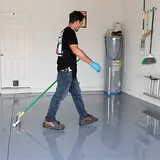
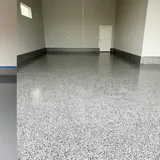
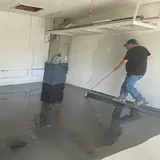
The 2026 figures put a flake system at $3–8 per square foot and polyaspartic at $5–9 per square foot, with a two-car garage landing between $2,500 and $6,000 installed. This guide shows what sits behind those numbers on a Reno slab, what a DIY kit really costs over 12 years, and how to read an itemised quote line by line.
At a glance
| System | Published cost |
|---|---|
| Flake epoxy system | $3–8 per square foot |
| Polyaspartic coating | $5–9 per square foot |
| Metallic epoxy | $10–$15 per square foot |
| Professional install, all systems | $5.00 to $15.00 per square foot |
| Two-car garage, installed | $2,500 to $6,000 |
Those are installed prices, not material prices. Preparation, moisture testing and any repair sit inside them, which is why two quotes for the same garage can differ while both are honest.
What a two-car garage totals installed
A two-car garage is the job quoted most often in the Truckee Meadows, and the published installed band is $2,500 to $6,000. Where you land inside that band is decided by three things: the square footage, how much surface preparation the slab needs, and whether a moisture vapour barrier is specified.
Ask for the square footage and the per-square-foot rate on the same quote, so the two can be checked against each other. A quote that shows only a total cannot be compared with anything.
What moves the price on a Reno slab
- Surface profile. The systems specified here call for an ICRI CSP 3–4 profile, produced by heavy diamond grinding or shot blasting rather than a light acid etch. That is slower work, and it is a requirement rather than an upgrade.
- Slab moisture. Readings need to sit below 5 lbs/1000 sq ft (ASTM F1869) or 75% RH (ASTM F2170). A slab above those numbers needs a dedicated moisture vapour barrier, which is a real added line.
- Slab age and strength. New concrete needs a minimum 28-day hydration period before coating. Commercial substrates are specified at a minimum 2,500 psi.
- What is under the slab. Valley-floor ground carries the Truckee series — poorly drained flood-plain and stream-terrace soils with a seasonal water table at 50–100 cm, saturated three or more months in most years. The fan and terrace ground above it carries the Reno series, with a duripan at 50–100 cm, low saturated hydraulic conductivity and a moderately alkaline profile (pH 8.0–8.4). Both put moisture testing on the quote.
- Cracks and joints. Active cracks and moving joints are routed, cleaned and filled with a flexible material before resin goes down. Each one is a line item.
- Exposure. A UV-stable topcoat, a chemical-resistant build, or an added slip-resistant aggregate all change the specification, and the specification is the price.
The DIY kit price and the 12-year maths
A retail DIY kit costs $60–$160. Over 12 years the same homeowner typically spends $720 to $1,920 in materials alone patching and recoating it. A professionally installed floor carries $0 in repair cost over that same period.
| Retail DIY kit | Professional system | |
|---|---|---|
| Cost | $60–$160 | $5.00 to $15.00 per square foot; $2,500 to $6,000 for a two-car garage |
| Dry film thickness | 2–5 mils | 20–35 mils (double broadcast) |
| Life | Fails inside 24 months | 12–15+ years before a topcoat rejuvenation |
| Maintenance over 12 years | $720 to $1,920 in materials | $0 in repair cost |
The kit is a film of paint-thickness resin. The professional system is a wear layer built from a primer, a build coat and a broadcast aggregate. They are not the same product at different prices.
How to read a Reno epoxy quote
- The square footage, and the per-square-foot rate, shown separately
- The preparation method — grinding or shot blasting — and the concrete surface profile to be achieved
- The result of the moisture testing: which standard was used (ASTM F1869 or ASTM F2170) and the actual reading
- Whether a moisture vapour barrier is included, and its product name
- The system by name and the dry film thickness promised in mils
- Crack routing, joint filling, spall repair and transitions, each itemised
- Which jurisdiction will be permitting the work, and who pays for it
- The workmanship warranty in writing, kept separate from any manufacturer warranty
Related: epoxy flooring cost guide · FAQ · system comparison · how the free matching works · request quotes.
Permits, water and timing
Confirm which jurisdiction the property sits in before anything is scheduled. The City of Reno Building & Safety division governs the incorporated city limits, but a Reno or Sparks mailing address can still sit in unincorporated Washoe County and be permitted by the county instead. Reno, Sparks, Washoe County and Douglas County share one regional online permit portal, so it is worth asking a pro which route they are using. Reno adopted the 2024 IRC with the 2024 Northern Nevada Amendments, effective 1 January 2026.
Water matters at two points: washing the slab before coating and cleaning it afterwards. Truckee Meadows Water Authority supplies 475,000+ residents of Reno, Sparks and Washoe County, and its hardness genuinely varies by neighbourhood — Central and Southeast Reno measured 62 mg/L (3.6 gpg) in the first quarter of 2026, against 238 mg/L (13 gpg) in Southwest Reno. Mineral residue has to be off the slab before resin goes on, and the harder the water, the more of it there is to remove.
Timing follows the weather. Reno runs a high-desert cycle: mean highs from about 45 °F in January to about 90 °F in July, an all-time record of 108 °F (16 July 2023) and a record low of −16 °F (7 February 1989), with roughly 30% average relative humidity in July. Intense summer surface heat, strong UV and hard winters with ice-melt chemicals are what the coating is being bought to survive.
Frequently asked questions
How much does epoxy flooring cost in Reno?
A flake epoxy system runs $3–8 per square foot and a polyaspartic coating $5–9 per square foot. Across all systems the professional install band is $5.00 to $15.00 per square foot, and a two-car garage usually lands between $2,500 and $6,000 installed.
Why is my quote higher than those bands?
Check the preparation method, whether a moisture vapour barrier is included, how many cracks and joints are being filled, the square footage, and the dry film thickness promised. A quote that reaches a CSP 3–4 profile, tests moisture to ASTM F1869 or F2170 and specifies a barrier is doing more work than one that does not.
Is a DIY kit really cheaper?
The kit costs $60–$160, but it produces a dry film of only 2–5 mils and commonly fails inside 24 months. Over 12 years the same homeowner spends $720 to $1,920 in materials patching it, against $0 in repair cost on a professional floor that is expected to run 12–15+ years before a topcoat rejuvenation.
Does a permit add cost to an epoxy floor?
It can, and the first question is jurisdiction: the City of Reno governs the incorporated limits, while a Reno or Sparks mailing address can sit in unincorporated Washoe County and be permitted by the county. Reno, Sparks, Washoe County and Douglas County share one regional online permit portal, and Reno adopted the 2024 IRC with the 2024 Northern Nevada Amendments effective 1 January 2026.
Where is the best place to spend on a Reno floor?
Preparation and moisture control. A surface profile of ICRI CSP 3–4 and moisture readings below 5 lbs/1000 sq ft (ASTM F1869) or 75% RH (ASTM F2170) are what make the floor stay down. Spending on a thicker decorative finish over a slab that was never profiled or tested is the expensive mistake.