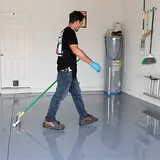
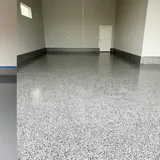
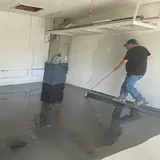
Three finishes, three different jobs. Epoxy is the thick classic build at the lowest cost, polyaspartic cures in a day and does not yellow in UV, and a concrete coating or sealer protects the slab without building a wear layer. In Reno the deciding factors are UV, summer surface heat, slab moisture and how fast the space has to go back to work.
The three finishes side by side
| Epoxy (flake) | Polyaspartic | Concrete coating & sealing | |
|---|---|---|---|
| Published cost | $3–8 per sq ft | $5–9 per sq ft | Quoted per project after an on-site assessment |
| Cure time | 3–7 days | Same day / next morning | Depends on the product; a sealer can be quicker than a build system |
| Return to service | After full cure | Foot traffic often in as little as 24 hours | As specified per product |
| UV stability | Ambers in direct sunlight | UV-stable | Surface protection rather than a coloured film |
| Best for | Garages, basements, workshops, interior slabs | Sun-exposed aprons, driveways, fast-turnaround spaces | Exterior and utility slabs needing sealing and surface protection |
Across all three, a professional installation runs from $5.00 to $15.00 per square foot depending on preparation and system complexity. Where a per-square-foot figure is not published for a product, the honest answer is that it needs a site-specific quote — not an invented average.
Where each finish belongs in a Reno building
Reno's exposure is the filter. Summer surface heat is intense — the record high is 108 °F (16 July 2023) — UV is strong at this altitude, July averages only about 30% relative humidity, and winters bring snow and ice-melt chemicals with a record low of −16 °F (7 February 1989).
- Interior garages, basements and workshops: a flake epoxy system at $3–8 per square foot, because the finish is not asked to survive direct sun.
- Anything the sun reaches — aprons, driveways, south-facing slabs: polyaspartic at $5–9 per square foot, because standard epoxy ambers in UV.
- Slabs that need protection rather than decoration: a concrete coating and sealing system, specified after the slab has been assessed for moisture and surface condition.
- Spaces that cannot be shut down: polyaspartic, because foot traffic can often resume in as little as 24 hours.
- Chemical or wash-down areas: whichever system the exposure calls for, with the topcoat chemistry matched to the substances present.
Cost, thickness and lifetime in one view
| Retail DIY kit | Professional system | |
|---|---|---|
| Cost | $60–$160 | $5.00 to $15.00 per sq ft; $2,500 to $6,000 for a two-car garage |
| Dry film thickness | 2–5 mils | 20–35 mils |
| Expected life | Fails inside 24 months | 12–15+ years before a topcoat rejuvenation |
| Maintenance over 12 years | $720 to $1,920 in materials | $0 in repair cost |
Note what the table is and is not comparing. It is a retail kit against a specified professional build. It is not epoxy against polyaspartic, which differ in UV stability and cure time rather than in whether they can do the job.
How to choose on a Truckee Meadows slab
Work in this order, because the order is the cost order.
- Test the slab first. Moisture to ASTM F1869 (below 5 lbs/1000 sq ft) and ASTM F2170 (below 75% RH), on a surface profiled to ICRI CSP 3–4. Ground here matters: the Truckee series is poorly drained flood-plain and stream-terrace soil with a seasonal water table at 50–100 cm, saturated three or more months in most years, while the Reno series has a duripan at 50–100 cm and low saturated hydraulic conductivity. A slab above the thresholds needs a moisture vapour barrier whatever finish you choose.
- Then decide on UV. If the slab sees direct sun, standard epoxy will amber and a UV-stable finish is the specification.
- Then match the chemistry to the exposure. Oils, solvents, acids and hot wash-downs each narrow the choice.
- Then set the downtime budget. A 3–7 day epoxy cure and a 24-hour polyaspartic return-to-service are different business decisions even where the price is close.
- Then compare itemised quotes — preparation method, moisture readings, mils, products, repairs and warranty, line by line.
Related: epoxy flooring cost guide · FAQ · system comparison · how the free matching works · request quotes.
Frequently asked questions
Is epoxy or polyaspartic better for a Reno garage?
For an interior garage that never sees direct sun, a flake epoxy system at $3–8 per square foot is the lower-cost match. For anything the sun reaches — aprons, driveways, south-facing slabs — polyaspartic at $5–9 per square foot is specified because standard epoxy ambers in UV.
Does polyaspartic cost more?
Yes. Polyaspartic runs $5–9 per square foot against $3–8 for a flake epoxy system. It returns to service far faster — foot traffic often in as little as 24 hours — and it does not yellow, which is what the extra buys.
What is the difference between a concrete coating and a floor coating system?
A concrete coating or sealing system protects the slab surface without building a decorative wear layer. A built epoxy or polyaspartic system adds the primer, build coat and broadcast aggregate that creates the thick surface most homeowners picture when they say epoxy floor.
Which one lasts longest?
A professionally installed system of either type is expected to run 12–15+ years before a topcoat rejuvenation. The variable that shortens that is preparation and slab moisture, not the brand: a retail kit producing only 2–5 mils of dry film typically fails inside 24 months regardless of what it is called.