Reno sits on ground that holds water in specific places. The Truckee soil series is very deep, poorly drained flood-plain and stream-terrace ground with a seasonal water table at 50-100 cm, saturated more than three months in most years, and the Reno series on the alluvial fans has a duripan at 50-100 cm with low saturated hydraulic conductivity. Snowmelt and ice-melt chemicals find those layers too. So a basement floor here is specified around moisture first: tested to ASTM F1869 and ASTM F2170, then covered with a system that includes a vapor barrier where the readings call for one. Published bands run $3-8 per square foot for flake and $5-9 for polyaspartic.
What it costs in Dayton
| Job | Published 2026 range |
|---|---|
| Flake system, per sq ft | $3 - $8 |
| Polyaspartic, per sq ft | $5 - $9 |
| Two-car garage, installed | $2,500 - $6,000 |
| Professional install, full range | $5.00 - $15.00 per sq ft |
| DIY upkeep over 12 years | $720 - $1,920 vs $0 on a professional system |
What a basement floor job involves
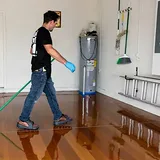
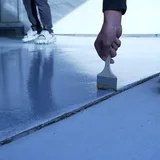
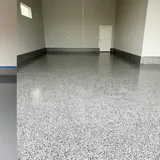
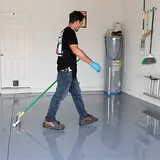
A basement is not a garage with a different address. The work starts with the slab: mechanical profiling to a CSP 3-4 anchor pattern, routing and flexible filling of moving cracks and control joints, and a penetrating primer to seal porosity. Then the film is built - a base coat carrying the first aggregate broadcast, a binder coat carrying the second, and a topcoat that becomes the walking surface.
Two details matter more downstairs than up. Cove base, where the floor turns up the wall, closes the joint that a mop and a spill both find. And ventilation or dehumidification during cure keeps vapor from condensing on a film that is still setting.
- Profile the slab mechanically, not with acid
- Route and fill moving joints with a flexible material such as EC-72 Epoxy Patch Gel
- Test moisture before choosing the system
- Specify a vapor barrier if either reading fails
- Build the aggregate broadcast to refusal, then scrape back the excess
Moisture is the design driver, not a detail
When vapor pushes up through a slab and meets a film that does not let it pass, the pressure has to go somewhere. It lifts the coating from below, and the result is edge blistering and bubbles that open, take in water and spread. That failure is a moisture failure - it happened before the first coat was mixed.
| Test | Standard | Pass threshold | If exceeded |
|---|---|---|---|
| Calcium chloride vapor emission | ASTM F1869 | Below 5 lbs per 1,000 sq ft | Specify a moisture vapor barrier |
| In-situ relative humidity | ASTM F2170 | Below 75% RH | Specify a moisture vapor barrier |
| New slab cure | Placement record | 28 days minimum hydration | Wait before coating |
A dedicated moisture vapor barrier such as EC-15 is engineered to hold back high vapor pressure and sit under the base coat. Ask for the numbers in writing - pounds for the F1869 test and percent relative humidity for the F2170 test - and for where on the slab each reading was taken. In a sloped basement the low corner often reads higher than the rest, and the worst number governs the specification.
Reno ground, snowmelt and what reaches a basement slab
The soils here are the reason basement floors get tested rather than assumed. Truckee series soils are poorly drained, with a seasonal water table at 50-100 cm and saturation lasting three or more months in most years. Reno series soils carry a duripan at 50-100 cm and drain slowly through it. Frost depth in this high-desert climate runs about 18-24 inches, so the ground around a foundation goes through a real freeze-thaw cycle each winter, and snowmelt plus ice-melt chemicals work down through it.
Reno is also a dry climate indoors and out, with average July relative humidity near 30% and a mean January low near 25 F. That combination - a slab in contact with ground that holds seasonal water, inside a room that stays dry - is exactly why the test matters rather than the thermometer.
Water quality is genuinely local here too. Truckee Meadows Water Authority serves more than 475,000 residents across Reno, Sparks and Washoe County, and its published neighbourhood data shows hardness of 62 mg/L (3.6 gpg) in Central and Southeast Reno in Q1 2026 against 238 mg/L (13 gpg) in Southwest Reno. Hard water leaves mineral film on a sealed floor and on mop water, so cleaning routine and residue differ street to street across the valley.
Local note for Dayton
Dayton sits on the Carson River corridor, which is the setting the Truckee series describes: very deep, poorly drained flood-plain and stream-terrace soils with a seasonal water table at 50-100 cm, saturated three or more months in most years (https://soilseries.sc.egov.usda.gov/OSD_Docs/T/TRUCKEE.html). On river ground the moisture that matters is under the slab, not on it, and it is why moisture testing and a moisture vapour barrier are part of the specification rather than an upsell.
Dayton sits in Lyon County, outside the footprint we can cite directly: Truckee Meadows Water Authority is community-owned and supplies 475,000+ residents of Reno, Sparks and Washoe County from the Truckee River system (https://tmwa.com/), so a Dayton address needs its serving utility confirmed rather than assumed. TMWA's own pages are still the clearest reference for how variable regional hardness is - 62 mg/L (3.6 gpg) in Central and Southeast Reno in Q1 2026 against 238 mg/L (13 gpg) in Southwest Reno (https://tmwa.com/water_quality/central-southeast-reno).
Utility accounts: Truckee Meadows Water Authority (TMWA) · 775-834-8177
Checking a quote in Dayton
- Who measures the slab, and is the area on the quote in square feet rather than a standard garage?
- What moisture test was run, and what were the readings (ASTM F1869 in lbs/1000 sq ft, or ASTM F2170 in % RH)?
- What surface profile is specified and how is it produced - grinding or shot blasting, to which ICRI CSP number?
- What dry film thickness is specified per coat, and which system is being quoted (flake, polyaspartic, metallic)?
- What does the workmanship warranty cover, separately from the manufacturer material warranty?
Frequently asked questions
Why do Reno basements need a vapor barrier when the climate is so dry?
Because the moisture comes from the ground, not the air. Truckee series soils are poorly drained with a seasonal water table at 50-100 cm and saturation for three or more months in most years, and the duripan in the Reno series slows drainage further. If a slab reads above 5 lbs per 1,000 sq ft on ASTM F1869 or above 75% RH on ASTM F2170, the system needs a barrier such as EC-15.
What does basement epoxy flooring cost?
Published bands are $3-8 per square foot for a flake system and $5-9 per square foot for polyaspartic, with professional installs generally $5.00 to $15.00 per square foot depending on preparation and whether a vapor barrier is required. A floor of a similar size to a two-car garage typically lands between $2,500 and $6,000 installed.
How long before I can use the basement again?
A fast-cure polyaspartic system allows foot traffic in as little as 24 hours. A slower build follows standard phasing: no pedestrian traffic for 0-48 hours, no vehicle or heavy equipment traffic before 72 hours, and full cure at five days.