Three garage floors in Reno can share the same slab, the same 20–35 mil build and the same crew, and still look nothing alike and age differently. The finish is the variable: a vinyl flake broadcast, a metallic pigment system, or a solid-colour pigmented topcoat. Each answers a different question about how the floor should look and what it has to survive. This article compares the three on the things that decide a Northern Nevada floor — film build, cost per square foot, UV exposure, hot-tire behaviour and winter ice-melt chemicals.
What Each Finish Actually Is
A flake system is a decorative vinyl flake broadcast into wet resin, usually in two passes so grain stacks through the film. It is the finish most often specified for working garages, because the flake carries colour and texture at the same time.
A metallic system suspends pigmented metallic particles in clear resin, which produces the marbled, three-dimensional movement the finish is known for. A solid-colour floor is a pigmented topcoat over a broadcast layer, so the surface reads as one even colour. That last one is the least forgiving to install and the easiest to repair invisibly, because a colour match is a pigment mix rather than a pattern.
The Double-Broadcast Stack Under All Three
Finish is the top of the system, not the whole system. A specified double-broadcast build is a primer or vapour barrier at 3 to 5 mils, a base coat carrying the first aggregate broadcast at 20 mils, an intermediate coat carrying the second broadcast, and a performance topcoat wear layer at 15 mils.
Added together that lands near 38 to 40 mils over a properly profiled slab. Two broadcasts give the floor mass, not just texture: the first keys the base coat into the profile preparation opened, and the second stacks grain so impact load is shared through the full build rather than shearing one shallow layer.
What Each Finish Costs
Cost follows the material and the labour in the finish rather than the colour chart.
| Finish | Installed cost | How it ages visibly |
|---|---|---|
| Vinyl flake, double broadcast | $3–8 per square foot | Hides tire marks, grit and light scuffs |
| Polyaspartic coating | $5–9 per square foot | Non-yellowing clear topcoat over pigment or flake |
| Metallic pigment | $10–$15 per square foot | Movement disguises some marks, exposes lap marks |
| Solid-colour topcoat | $5.00 to $15.00 per square foot professional range | Shows every scuff and tire lap |
A two-car garage typically falls between $2,500 and $6,000. A retail DIY kit costs $60–$160, and the gap between that and a specified system is the build underneath the finish, not the colour.
How High-Desert Light Treats Each Finish
Reno records 108 °F and −16 °F, with mean highs near 45 °F in January and 90 °F in July and July relative humidity near 30 percent. Ultraviolet exposure at this elevation is intense, and a finish that drifts amber or chalks under it looks tired no matter how well the resin performed.
That is why the topcoat specification matters more than the flake pattern. A non-yellowing polyaspartic topcoat sits over the pigment layer and takes the UV load. On a metallic floor the clear coat is doing more work than usual, because it is protecting a decorative film rather than a broadcast aggregate.
Hide or Show: How the Three Age
Solid colour shows everything. A tire lap, a dropped-tool mark, a dust bloom and every scuff read clearly against an even surface, useful in a shop, unforgiving in a family garage that sees snow, grit and road spray.
Hard water shows on a finish too. TMWA publishes water quality by neighbourhood and in its annual water quality report, and hardness runs from 62 mg/L (3.6 gpg) in Central and Southeast Reno to 238 mg/L (13 gpg) in Southwest Reno. Mineral spotting reads more clearly on a dark solid-colour or gloss metallic floor.
Flake hides most of it, because the pattern breaks up how the eye reads small damage. Metallic sits in between: the movement disguises some marks and exaggerates others, and lap marks left during installation stay visible, which is why the finish rewards an experienced crew. The garage door apron wears first on all three, because that is where vehicles cross with grit and brine.
Winter Chemicals and Slip Resistance
Ice-melt products, road brine and the salt a car brings in on its tyres are the local test that a smooth decorative finish fails fastest. A gloss finish in a garage that parks two snow-covered vehicles is a traction decision as much as a design one.
Chemical resistance ratings are published per product, and the shorthand matters: LT means long-term contact, a number is an exposure limit in hours, SS means splash and spill with same-day clean-up, and NR means the chemical should not touch the floor. Ask for the rating that applies to the de-icer you actually use, and specify texture in the apron and walkway areas.
Frequently asked questions
How much do the three finishes cost per square foot?
Flake runs $3–8 per square foot, polyaspartic $5–9 per square foot, and metallic $10–$15 per square foot. Professional installation across systems lands between $5.00 and $15.00 per square foot, and a two-car garage between $2,500 and $6,000.
Which finish suits a working garage in Reno?
Flake, in most cases. The double-broadcast pattern hides tire marks and grit, adds texture for wet and icy shoes, and does not show lap marks the way a metallic finish can. Metallic is a feature finish, not a durability upgrade.
Does a metallic floor need a different topcoat?
It needs a UV-stable one, because a non-yellowing polyaspartic clear coat is what keeps a decorative pigment layer from drifting amber under intense high-desert light. That topcoat also carries the wear and chemical resistance for the whole system.
How long do these systems last?
A specified double-broadcast system is built around 12 to 15+ years before a topcoat rejuvenation. A thin DIY film commonly fails inside 24 months, and that failure is a preparation and build problem rather than a colour choice.
Can a new finish go over an existing coated floor?
Sometimes. The existing coating has to be tested for adhesion and the slab checked for moisture first. Loose or failing coating has to come off, and the surface still has to reach CSP 3 to 4 before anything new goes down.
Sources
- NWS Reno climate products (Reno–Tahoe International Airport)
- TMWA water quality by neighbourhood: Central and Southeast Reno
- TMWA 2026 water quality report (2025 data)
Related
Epoxy Flooring services in Reno
Garage Epoxy
A Reno garage slab works harder than any other floor in the house: summer surface heat, winter ice-melt brine, and a car that parks in the same two spots every night.
Basement Epoxy
A basement floor in Reno is a moisture question before it is a finish question, and the answer is decided by the slab, not by the coating.
Commercial Epoxy
A commercial floor is bought in hours of uptime, not in square feet of resin.
Metallic Epoxy
Metallic epoxy is a design floor built on an engineering system: the swirl is the topcoat's business, the bond is the slab's.
Polyaspartic Coatings
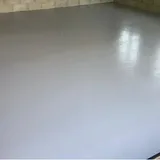
Polyaspartic is the coating that made the one-day floor possible, and it is the layer that decides how a Reno floor ages under a high-desert sun.
Concrete Coating Sealing
Raw concrete is a working surface, not a finished one, and sealing it is the cheapest way to stop dusting, staining and moisture at the surface.
Areas we serve
Reno
Epoxy Flooring in Reno, NV - costs, water and soil notes.
Sparks
Epoxy Flooring in Sparks, NV - costs, water and soil notes.
Sun Valley
Epoxy Flooring in Sun Valley, NV - costs, water and soil notes.
Spanish Springs
Epoxy Flooring in Spanish Springs, NV - costs, water and soil notes.
Fernley
Epoxy Flooring in Fernley, NV - costs, water and soil notes.
Dayton
Epoxy Flooring in Dayton, NV - costs, water and soil notes.
Carson City
Epoxy Flooring in Carson City, NV - costs, water and soil notes.