A garage slab in Reno is not a climate-controlled room. It takes orders from the weather on the other side of the door, and the high desert does not negotiate. NWS Reno records put mean highs near 45 °F in January and about 90 °F in July, with an all-time record of 108 °F on 16 July 2023 and a record low of −16 °F on 7 February 1989. That is roughly a 124-degree band, plus a daily swing that moves the slab again every single day. The useful specification is not a marketing word like durable. It is a stated temperature range, and a stated behaviour at each end of it.
The Two Ends of a Reno Year
Mean highs run from about 45 °F in January to about 90 °F in July, and mean lows run from about 25 °F in January to about 56 °F in July. The extremes are wider: 108 °F on 16 July 2023, and −16 °F on 7 February 1989.
A coating on a Reno slab is expected to survive both, in the same year, under the same parked car. A product formulated for mild swings can look healthy through a season and then fail the first time the surface climbs past what it was built to tolerate, usually in order: fading, then chalking, then blisters along the traffic lanes. The fix is not a thicker coat of the same chemistry. It is chemistry chosen for the range.
Heat: Surface Temperature Is Not Air Temperature
A dark coated slab in direct sun collects solar energy and runs well above the air around it, and the tire patches on top of it run hotter still. Roughly 30% average July relative humidity means there is very little moisture in the air to shed that heat by evaporation, so it stays in the surface.
Heat does two things to a floor at once. It accelerates moisture vapour transmission through the concrete, sending vapour upward at the exact moment the coating above it is at its softest, and it softens any film that re-softens with temperature. A rigid film cannot absorb that combination: it holds its shape until the stress beneath it exceeds its tolerance, then it lets go.
Cold: What −16 °F Does to a Cured Film
The cold end of the range is quieter and just as destructive. When a hard freeze drives a Reno slab toward the bottom of its window, the concrete contracts, and any moisture that worked into a hairline crack during the wet months has already frozen and expanded inside it. A coating that cured brittle has no elasticity left to give at that temperature, so the crack telegraphs straight through the film.
Thickness and chemistry combine here. A 20–35 mil build has both the body and the flexibility to move with a contracting slab, while a 2–5 mil film on the surface can only crack with it.
The Daily Swing Is the Real Load
The number that matters most is not either endpoint. It is the distance between them, and how often the slab travels that distance.
A high-desert slab works through a wide band every day: cool at dawn, warming fast through the morning, at peak in the afternoon, then shedding heat rapidly after sunset in dry air. That means the slab is expanding and contracting thousands of times across the life of a floor, not twice a year. A film that cured rigid resists that movement and concentrates stress at the perimeter, where the coating meets a wall or a stem. A film engineered to move with the concrete follows it instead. This is why the specification pairs chemistry with thickness.
Freeze-Thaw and the Chemicals That Come With It
Northern Nevada winters bring snow, and snow brings ice-melt chemicals. Salt and brine arrive on tires and sit on the same four contact patches where the coating is already under thermal stress, as a concentrated wet film rather than a quick spill.
That is why a chemical resistance chart matters as much as a temperature range. On a published ratings key, LT means long-term exposure with 72+ hours of contact, and SS means splash and spill, requiring clean-up within 24 hours. A wear layer rated for gasoline drips is not automatically rated for months of brine. Read the chart against what actually lands on your slab, because a floor that is right for motor oil can be the wrong floor for a Reno driveway in February.
What to Ask For in a Reno Specification
- The stated application and operating range in degrees.
- Finished dry film thickness of 20–35 mils in writing, against 2–5 mils for a retail kit.
- An ICRI Concrete Surface Profile of CSP 3–4 from diamond grinding or shot blasting, so the resin locks into opened concrete.
- Slab moisture below 5 lbs/1000 sq ft on ASTM F1869 or 75% RH on ASTM F2170, with a barrier if readings run higher, 28 days of hydration on new concrete, and 2,500 psi minimum on a commercial slab.
- The right jurisdiction. Reno adopted the 2024 IRC with the 2024 Northern Nevada Amendments effective 1 January 2026, and a Reno or Sparks mailing address can sit in unincorporated Washoe County, so confirm which one owns the permit.
Frequently asked questions
How wide a temperature range does a Reno garage see?
Records for the area run from 108 °F on 16 July 2023 to −16 °F on 7 February 1989, with mean highs between about 45 °F in January and 90 °F in July. The surface of a sun-loaded slab runs higher than the air on the hot end.
Why does heat make a floor coating bubble?
Because heat accelerates moisture vapour transmission through the concrete while softening the film above it. Rising vapour pressure needs somewhere to go, and a thin, rigid film gives way before the slab does.
Does a thicker coat alone solve a temperature problem?
No. Thickness helps, but a rigid chemistry at 20–35 mils is still rigid. The system has to move with the slab across the full annual range, which is why chemistry and thickness are specified together rather than one at a time.
What does the cold end of the range do?
The slab contracts, and water that found a hairline crack during the wet months freezes and expands inside it. A brittle film has no elasticity left at those temperatures, so the crack telegraphs through the coating instead of being absorbed.
Sources
- NWS Reno climate products (Reno–Tahoe International Airport records)
- City of Reno Building & Safety — building codes and permits
- ONE regional permit portal (Reno, Sparks, Washoe County, Douglas County)
- TMWA water quality — Central and Southeast Reno neighbourhood profile
Related

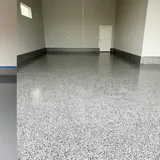
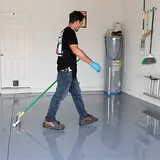
Epoxy Flooring services in Reno
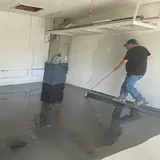
Garage Epoxy
A Reno garage slab works harder than any other floor in the house: summer surface heat, winter ice-melt brine, and a car that parks in the same two spots every night.
Basement Epoxy
A basement floor in Reno is a moisture question before it is a finish question, and the answer is decided by the slab, not by the coating.
Commercial Epoxy
A commercial floor is bought in hours of uptime, not in square feet of resin.
Metallic Epoxy
Metallic epoxy is a design floor built on an engineering system: the swirl is the topcoat's business, the bond is the slab's.
Polyaspartic Coatings
Polyaspartic is the coating that made the one-day floor possible, and it is the layer that decides how a Reno floor ages under a high-desert sun.
Concrete Coating Sealing
Raw concrete is a working surface, not a finished one, and sealing it is the cheapest way to stop dusting, staining and moisture at the surface.
Areas we serve
Reno
Epoxy Flooring in Reno, NV - costs, water and soil notes.
Sparks
Epoxy Flooring in Sparks, NV - costs, water and soil notes.
Sun Valley
Epoxy Flooring in Sun Valley, NV - costs, water and soil notes.
Spanish Springs
Epoxy Flooring in Spanish Springs, NV - costs, water and soil notes.
Fernley
Epoxy Flooring in Fernley, NV - costs, water and soil notes.
Dayton
Epoxy Flooring in Dayton, NV - costs, water and soil notes.
Carson City
Epoxy Flooring in Carson City, NV - costs, water and soil notes.