A Reno garage floor meets its hardest test in July, not January. A car parked on sun-loaded pavement rolls in with tires carrying concentrated heat, and that heat goes straight into whatever film is on the slab. The high desert does the rest: July mean highs near 90 °F, a record 108 °F set on 16 July 2023, roughly 30% average July relative humidity, and a coated surface that runs hotter than the air above it. Two failures follow, and they are different problems. One is tire-shaped peel in the parking lanes. The other is a chalky white mark that looks like a stain and is not.
Why a Reno Tire Arrives Hotter Than the Air
A tire does not have to be driven hard to carry serious heat into a garage. Pavement absorbs solar energy all day, and rubber resting on it takes on the surface temperature beneath it. Sun-loaded asphalt and a dark coated slab both run well above the air above them, and at roughly 30% average July relative humidity there is very little water in the air to pull heat back out of a surface by evaporation.
The load is also static. The same tire sits on the same square foot of coating, day after day, season after season, so heat and pressure land on the same few patches, and the damage arrives in tire shapes.
Thermoplastic Versus Thermoset: The Property That Decides
The difference between a floor that survives a Reno summer and one that does not is whether the film can be re-softened by heat. A thermoplastic film has a temperature at which it goes soft and pliable again. Once a hot tire pushes the surface past that point, the film is no longer a solid; it is a soft layer waiting to be gripped. As the tire cools it contracts, and contracting rubber pulls the softened coating off the slab. That is a tear, not wear.
A thermoset film cures through a chemical reaction that heat cannot undo, so it never returns to a soft state at summer temperatures and the tire has nothing to grab.
The White Spot Is Not Dirt
White or chalky patches under the parking spots are usually read as a stain, and scrubbing confirms the misreading, because scrubbing does not remove them. The mark is plasticiser transfer.
Tire rubber is formulated with plasticisers and process oils that keep it flexible, and under heat and steady pressure those compounds migrate out of the rubber and into whatever film is against it. On an under-cured or low-quality film the plasticiser soaks in and becomes part of the coating, leaving a pale, permanent ghost of the contact patch. On a fully cured wear layer the transfer cannot penetrate; it sits on the surface and wipes off. The white spot is a diagnostic, not a cosmetic complaint.
Why Thin and Under-Cured Films Fail First
Two numbers sit behind almost every hot-tire failure, and neither is visible on a finished floor. The first is dry film thickness. A retail kit laid down at home typically cures at 2–5 mils, roughly the thickness of a sheet of paper, while a professional double-broadcast system builds 20–35 mils. A paper-thin film has no material to sacrifice, so every bit of plasticiser or heat that reaches it matters immediately.
The second is cure state. A new concrete slab needs 28 days of hydration before any coating goes on, and the film itself must reach full cure before daily traffic. Tires parked on a film that is still cross-linking create a soft spot that never fully hardens.
What Actually Resists It in a Reno Garage
Resistance is a specification, not a maintenance habit. Once a floor carries a thermoplastic film, no sealer, mat or careful parking habit will stop a hot tire from softening it. The property has to be built in on install day.
Polyaspartic topcoats cure to a thermoset surface and are UV stable, which matters in a high-desert market where the same sunlight that heats a slab also attacks an unstable film. Published system guides put a flake system at $3–8 per square foot, a polyaspartic system at $5–9 per square foot, and a typical two-car garage installation at $2,500 to $6,000 depending on slab condition. The flake supplies the pattern; the topcoat chemistry supplies the resistance.
What to Confirm Before a Coating Goes Down
- Dry film thickness in writing — 20–35 mils for a professional build against 2–5 mils for a kit.
- Concrete Surface Profile of CSP 3–4, produced by diamond grinding or shot blasting rather than an acid wash.
- Slab moisture below 5 lbs/1000 sq ft on ASTM F1869 or 75% RH on ASTM F2170, with a moisture vapour barrier if readings are higher.
- A substrate at 2,500 psi minimum on a commercial slab, and 28 days of hydration on new concrete.
- Wash water and residue: TMWA hardness runs about 62 mg/L in Central and Southeast Reno against 238 mg/L in Southwest Reno, and hard water left to dry on an opened slab leaves mineral film that must come off before primer.
Ask for the topcoat chemistry by name, and what pavement temperature it is rated to handle.
Frequently asked questions
What causes hot-tire peel on a garage floor?
A coating that softens under heat. Once a hot tire raises the film past its softening point, the surface stops being a solid. As the tire cools it contracts and grips the softened coating, tearing it off the concrete.
What is the white spotting under my tires?
Plasticiser transfer, not dirt and not a stain. Tire rubber releases plasticisers under heat and pressure, and an under-cured or low-quality film absorbs them permanently, leaving a pale ghost of the contact patch that no cleaner removes.
Can a peeled floor be repaired?
Small areas can be cut back and recoated, but the surrounding film is the same chemistry, so new tire-shaped failures keep appearing. A durable fix means replacing the system over a properly profiled slab.
Does a polyaspartic topcoat really stop this?
Yes, if it is a genuine thermoset and fully cured. It does not re-soften at summer surface temperatures and resists penetration by oils and plasticisers, so the tire has nothing to grip and the white transfer wipes off.
Sources
- NWS Reno climate products (Reno–Tahoe International Airport records)
- TMWA water quality — Central and Southeast Reno neighbourhood profile
- TMWA 2026 water quality report (2025 data)
- USDA-NRCS official soil series description — Reno series
Related
Epoxy Flooring services in Reno
Garage Epoxy
A Reno garage slab works harder than any other floor in the house: summer surface heat, winter ice-melt brine, and a car that parks in the same two spots every night.
Basement Epoxy
A basement floor in Reno is a moisture question before it is a finish question, and the answer is decided by the slab, not by the coating.
Commercial Epoxy
A commercial floor is bought in hours of uptime, not in square feet of resin.
Metallic Epoxy
Metallic epoxy is a design floor built on an engineering system: the swirl is the topcoat's business, the bond is the slab's.
Polyaspartic Coatings
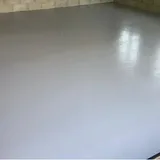
Polyaspartic is the coating that made the one-day floor possible, and it is the layer that decides how a Reno floor ages under a high-desert sun.
Concrete Coating Sealing
Raw concrete is a working surface, not a finished one, and sealing it is the cheapest way to stop dusting, staining and moisture at the surface.
Areas we serve
Reno
Epoxy Flooring in Reno, NV - costs, water and soil notes.
Sparks
Epoxy Flooring in Sparks, NV - costs, water and soil notes.
Sun Valley
Epoxy Flooring in Sun Valley, NV - costs, water and soil notes.
Spanish Springs
Epoxy Flooring in Spanish Springs, NV - costs, water and soil notes.
Fernley
Epoxy Flooring in Fernley, NV - costs, water and soil notes.
Dayton
Epoxy Flooring in Dayton, NV - costs, water and soil notes.
Carson City
Epoxy Flooring in Carson City, NV - costs, water and soil notes.