Two garage floors on the same Sparks street can be coated the same weekend and look identical on Sunday night. Two summers later one is mopped and the other is patched, and the difference is written on the spec sheet as two small numbers. Dry film thickness, or DFT, is what is actually left on the slab after the coating cures. This article answers the question Reno and Northern Nevada homeowners ask first: does a thicker film or a tougher resin decide how long the floor lasts, and which number belongs on a quote?
What a Mil Measures, and Why the Dry Number Counts
A mil is one thousandth of an inch, measured on the dry film rather than on the wet coating going into the bucket. That distinction matters because chemistries lose volume at different rates as they cure. A water-based product loses most of its volume to evaporation; a 100 percent solids product keeps essentially all of it.
So the same wet film thickness can still leave two very different floors, and a quote written in gallons per square foot tells you very little. A 2–5 mil film is about the thickness of a single sheet of paper sitting on concrete.
The Layer Stack Behind a 20–35 Mil Build
A full-thickness floor is a stack, not one thick pour: a deep-penetrating primer that keys into the profiled slab, a decorative flake or quartz layer that adds colour and abrasion resistance, and a UV-stable clear topcoat that protects everything below it from sunlight. Each layer contributes part of the 20–35 mil total, and each has a job.
The primer manages adhesion, the flake layer manages wear, and the clear topcoat manages UV exposure. Remove a layer and the system loses that function. A retail kit skips the stack: one application of pigmented product, spread as far as the bucket allows.
Why Thickness Without Flexibility Still Cracks
A rigid coating at 20–35 mils is still rigid. Chemistry is what lets thickness do its job: a flexible hybrid matrix moves with the slab through big daily and seasonal temperature swings, while a rigid latex or standard epoxy film of the same gauge cracks when the concrete moves.
Thin and brittle is the worst combination, because the film has neither the body to absorb impact nor the flexibility to survive movement. Thick and flexible holds both properties at once, which is why the two numbers — 20–35 mils and 100 percent solids — belong in the same sentence on the same quote.
What High-Desert Light and Heat Do to a Thin Film
Reno runs mean highs near 45 °F in January and 90 °F in July, with records of 108 °F and −16 °F, and July relative humidity near 30 percent. Sun at this elevation is intense, and a slab in full afternoon sun gets hotter than the air around it.
A 2–5 mil film has nothing to give under that load. UV drives ambering and chalking in a water-based film, hot tire contact marks it, and vapour rising from a warm slab pushes at a film with no thickness to resist. A 20–35 mil build with a UV-stable topcoat is the specification this climate rewards.
One local note on maintenance: TMWA publishes water quality by neighbourhood, and hardness runs from 62 mg/L (3.6 gpg) in Central and Southeast Reno to 238 mg/L (13 gpg) in Southwest Reno, so harder water leaves mineral film.
What the Thickness Specification Costs
Cost follows the build. A flake system runs $3–8 per square foot and a polyaspartic coating $5–9 per square foot, with professional installation across systems landing between $5.00 and $15.00 per square foot. A two-car garage typically falls between $2,500 and $6,000, and that figure moves with slab condition, not with the flake pattern.
On the other side of the same comparison, a retail DIY kit costs $60–$160. The number that separates them is not the bucket price but the lifecycle: a professional system is built around 12 to 15+ years before a topcoat rejuvenation, while a DIY film commonly fails inside 24 months.
What to Ask For in Writing
Ask about the slab as well as the film. USDA-NRCS describes the Truckee series as poorly drained soil with a seasonal water table at 50 to 100 cm that is saturated three or more months in most years, which is a vapour drive pushing upward at the coating from underneath.
Ask for the dry film thickness in mils, not in adjectives. Ask how many separate applications add up to it, because a single application of one product is a 2–5 mil result regardless of the brand on the pail. Ask what chemistry the resin is and whether the topcoat is UV-stable.
Then ask what the floor should look like at five years, not five days. A quote that can answer in mils and layer counts was built from a specification; a quote that cannot is a promise. As an independent matching service we do not install floors. We help homeowners compare providers who put those numbers in writing.
Frequently asked questions
How thick is 20–35 mils in practical terms?
It is a film with body. A 2–5 mil coating is the thickness of one sheet of paper; a 20–35 mil build is a multi-layer shield with a primer, a decorative flake or quartz layer and a UV-stable clear topcoat.
Does a 100 percent solids coating really perform better?
It cures without losing volume to evaporation, so the film left on the slab is the film that was specified. Water-based and fortified latex products finish at 2–5 mils DFT, which is why they chip and peel while a 20–35 mil system holds.
Can I just add more coats of a thin product?
Multiple coats of a film that dries brittle still dry brittle, and each coat adds a cure window. The strength figure comes from a full build in a flexible chemistry, not from repeating a thin film until the number looks right.
Do I need a thicker system in Reno than somewhere milder?
The local drivers are the daily and seasonal swing, intense UV, summer surface heat and hard winters with ice-melt chemicals. Those conditions reward a full 20–35 mil build with a UV-stable topcoat more than a milder climate would.
What do these systems cost per square foot?
A flake system runs $3–8 per square foot and a polyaspartic coating $5–9 per square foot, with professional installation between $5.00 and $15.00 per square foot. A two-car garage typically lands between $2,500 and $6,000.
Sources
- NWS Reno climate products (Reno–Tahoe International Airport)
- USDA-NRCS Official Soil Series Description: Truckee series
- TMWA water quality by neighbourhood: Central and Southeast Reno
Related

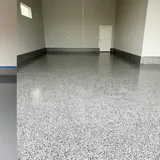
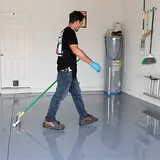
Epoxy Flooring services in Reno
Garage Epoxy
A Reno garage slab works harder than any other floor in the house: summer surface heat, winter ice-melt brine, and a car that parks in the same two spots every night.
Basement Epoxy
A basement floor in Reno is a moisture question before it is a finish question, and the answer is decided by the slab, not by the coating.
Commercial Epoxy
A commercial floor is bought in hours of uptime, not in square feet of resin.
Metallic Epoxy
Metallic epoxy is a design floor built on an engineering system: the swirl is the topcoat's business, the bond is the slab's.
Polyaspartic Coatings
Polyaspartic is the coating that made the one-day floor possible, and it is the layer that decides how a Reno floor ages under a high-desert sun.
Concrete Coating Sealing
Raw concrete is a working surface, not a finished one, and sealing it is the cheapest way to stop dusting, staining and moisture at the surface.
Areas we serve
Reno
Epoxy Flooring in Reno, NV - costs, water and soil notes.
Sparks
Epoxy Flooring in Sparks, NV - costs, water and soil notes.
Sun Valley
Epoxy Flooring in Sun Valley, NV - costs, water and soil notes.
Spanish Springs
Epoxy Flooring in Spanish Springs, NV - costs, water and soil notes.
Fernley
Epoxy Flooring in Fernley, NV - costs, water and soil notes.
Dayton
Epoxy Flooring in Dayton, NV - costs, water and soil notes.
Carson City
Epoxy Flooring in Carson City, NV - costs, water and soil notes.