A garage floor that looked flawless in April can carry a field of pinholes and blisters by August, and none of it is wear. Outgassing is thermal. Concrete holds moisture, warming concrete drives that moisture upward as vapour, and if a film is sitting on the slab while the vapour is still escaping, the pressure opens a path through the coating from below. Reno and Northern Nevada make this worse in a specific way: the high desert swings hard between night and day, so a slab that is cool at dawn is warming fast by mid-morning. That warming curve is the outgassing window, and the schedule decides whether the film sets clean.
What Outgassing Actually Is
Concrete is porous and always holds some moisture, some of it leftover mix water from the pour and some migrating up from the ground beneath the slab. When the slab warms, that moisture turns to vapour, expands, and travels toward the surface.
The problem starts when a film is already sitting on top of the slab while vapour is still being released. The vapour reaches the underside of the coating, finds the weakest point in the bond line or a thin spot in the film, and pushes through. If the coating is still liquid, the bubble pops and leaves a crater with a raised lip. If it has already skinned over, the same pressure lifts a section of film instead.
Why Reno's Daily Swing Opens the Window
Reno sits in a high desert, which means a wide spread between the overnight low and the afternoon high, and dry air that lets a slab shed heat quickly after sunset. NWS Reno records put mean lows near 25 °F in January and around 56 °F in July, against mean highs near 45 °F and 90 °F for the same months.
A slab gives up heat overnight and starts climbing shortly after sunrise. Apply a coating mid-morning and you are laying it over a slab that warms for hours, so vapour pressure under the film rises while the film is still soft enough to be pushed around.
The Descending-Temperature Rule
The practical fix is to apply on a descending temperature cycle: work while the slab is cooling rather than while it is warming, so vapour pressure under the film falls as the coating sets instead of climbing. On a Reno schedule that usually means a late-afternoon start that runs into the evening, after the slab has peaked for the day.
It also means measuring the temperature of the concrete rather than the air, and checking it again before the topcoat goes on. A stated application window is a floor and a ceiling: too cold and the reaction stalls, too hot and the film skins before trapped air can escape.
Craters, Pinholes and Blisters Are Not the Same
Homeowners describe all three as bubbles, but they point at different timing.
| What you see | When it happened | What it means |
|---|---|---|
| Pinhole craters with raised rims | Vapour broke through while the film was still liquid | The slab was warming during the open time of the coat |
| Raised blisters that sound hollow | Vapour pushed after the film skinned over | Bond had not developed where the film lifted |
| Edge lifting near the garage door | Stress concentrated at the perimeter | A rigid film fighting slab movement |
The diagnostic worth remembering is the clean concrete behind a lifted sheet. No concrete stuck to the back of the film means the coating never bonded, which is a moisture and scheduling failure rather than an abrasion one.
Why a Slow Cure Widens the Window
Traditional epoxy is slow. It stays workable for many hours and forms a rigid film as it sets, so the outgassing window stays open for the better part of a day.
Rapid-cure systems attack the problem from the cure side: a fast-curing top end closes the window before vapour has time to work its way into the resin, and a flexible film follows the slab as it expands and contracts instead of resisting it. A hard film concentrates stress at the perimeter, which is why edge blistering is often the first visible symptom rather than a crater in the middle of the field. The right answer is usually a system, not a single product.
The Slab Numbers and the Soils Behind Them
The slab has to be read before any of this is scheduled. Standard thresholds for a Westcoat-style system are below 5 lbs/1000 sq ft on ASTM F1869 or 75% RH on ASTM F2170, with a moisture vapour barrier specified when readings come back higher. New concrete needs 28 days of hydration, and a commercial substrate should test at 2,500 psi minimum with an ICRI Concrete Surface Profile of CSP 3–4 opened by diamond grinding or shot blasting.
Northern Nevada soils explain why two slabs a mile apart read differently. The Truckee series is very deep and poorly drained, with a seasonal water table at 50–100 cm and saturation for three or more months in most years. The Reno series is well drained but carries a duripan at 50–100 cm with low saturated hydraulic conductivity, which can perch water above it.
Frequently asked questions
Why is my epoxy floor bubbling in the heat?
Bubbles that appear as temperatures rise are almost always slab vapour escaping under the film. It points to moisture that was never tested, a barrier that was never specified, or a film that stayed soft long enough for vapour to push through.
What are the little craters with raised edges?
Pinhole craters, and their timing differs from blisters. Vapour broke through while the coating was still liquid, so the film opened and re-formed around the escape path. They show up most on slabs that were warming during the open time of the coat.
Can a bubbled floor be repaired?
Local blisters can sometimes be cut out, dried and recoated. Once the lifted edges have curled, the bond is gone across that area. The real fix is finding the moisture source, testing the slab, and rebuilding with a system that closes the outgassing window.
Does a fast-cure system still need moisture testing?
Yes. A fast cure shrinks the outgassing window, it does not eliminate vapour. The slab still has to come in below 5 lbs/1000 sq ft on ASTM F1869 and 75% RH on ASTM F2170, or a moisture vapour barrier joins the specification.
Sources
- NWS Reno climate products (temperature and humidity records)
- USDA-NRCS official soil series description — Truckee series
- USDA-NRCS official soil series description — Reno series
- USDA-NRCS official soil series description — Washoe series
Related
Epoxy Flooring services in Reno
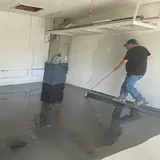
Garage Epoxy
A Reno garage slab works harder than any other floor in the house: summer surface heat, winter ice-melt brine, and a car that parks in the same two spots every night.
Basement Epoxy
A basement floor in Reno is a moisture question before it is a finish question, and the answer is decided by the slab, not by the coating.
Commercial Epoxy
A commercial floor is bought in hours of uptime, not in square feet of resin.
Metallic Epoxy
Metallic epoxy is a design floor built on an engineering system: the swirl is the topcoat's business, the bond is the slab's.
Polyaspartic Coatings
Polyaspartic is the coating that made the one-day floor possible, and it is the layer that decides how a Reno floor ages under a high-desert sun.
Concrete Coating Sealing
Raw concrete is a working surface, not a finished one, and sealing it is the cheapest way to stop dusting, staining and moisture at the surface.
Areas we serve
Reno
Epoxy Flooring in Reno, NV - costs, water and soil notes.
Sparks
Epoxy Flooring in Sparks, NV - costs, water and soil notes.
Sun Valley
Epoxy Flooring in Sun Valley, NV - costs, water and soil notes.
Spanish Springs
Epoxy Flooring in Spanish Springs, NV - costs, water and soil notes.
Fernley
Epoxy Flooring in Fernley, NV - costs, water and soil notes.
Dayton
Epoxy Flooring in Dayton, NV - costs, water and soil notes.
Carson City
Epoxy Flooring in Carson City, NV - costs, water and soil notes.