Retail, warehouse, workshop and medical space across Reno, Sparks and the surrounding valley all put the same two loads on a slab: vehicles and chemicals. The published bands are $3-8 per square foot for a flake system, $5-9 for polyaspartic, and $5.00 to $15.00 per square foot for a professional installation, with metallic finishes at $10-$15. What decides the quote is the substrate - a minimum 2,500 psi slab with at least 28 days of hydration, profiled to CSP 3-4 and tested for moisture - because a floor that fails during service stops the building. We are a free matching service, not a contractor.
What it costs in Fernley
| Job | Published 2026 range |
|---|---|
| Flake system, per sq ft | $3 - $8 |
| Polyaspartic, per sq ft | $5 - $9 |
| Two-car garage, installed | $2,500 - $6,000 |
| Professional install, full range | $5.00 - $15.00 per sq ft |
| DIY upkeep over 12 years | $720 - $1,920 vs $0 on a professional system |
What a commercial job involves
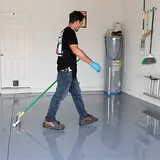
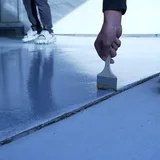
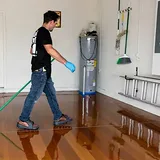
The sequence is the same as a residential floor, run at a larger scale and against a schedule. Surface preparation comes first: shot blasting or diamond grinding across the field to reach a CSP 3-4 profile, hand grinders at columns, drains and stem walls, and HEPA extraction running at the tool head throughout. Moving cracks and control joints are routed, vacuumed and filled with a flexible material such as EC-72 Epoxy Patch Gel so the slab can move without telegraphing a crack up through the finished surface.
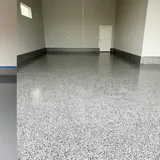
Then the system is built in layers: a penetrating primer, a base coat with the first aggregate broadcast, a binder coat with a second broadcast, and a topcoat chosen for the exposure. On a commercial site the topcoat choice is a specification decision, not a preference, because that layer is what the forklift tires and the spill actually touch.
| Layer | Published build | Job on a commercial slab |
|---|---|---|
| Primer | 3-5 mils | Seals porosity and anchors the system |
| Base coat with first broadcast | 20 mils | Bond line for the aggregate |
| Second broadcast in binder | Broadcast-driven | Impact load shared through the matrix |
| Performance topcoat | 15 mils | Renewable wear surface |
Uptime is the real number on the quote
A resinous floor that fails during service does not just cost the rework. Published specification figures bar traffic after a failure for 48 hours for pedestrians and 72 hours for vehicles, and in a working facility that is lost production, not inconvenience.
That is why fast-cure chemistry is specified where the building cannot stand empty. A 100% solids polyaspartic system allows foot traffic in as little as 24 hours. A slower build follows standard phasing: no pedestrian traffic for 0-48 hours, no vehicle or forklift traffic before 72 hours, and full cure at five days, when the floor is rated for heavy abrasion and chemical exposure. Write the schedule around shifts rather than around installation day.
| Phase | Timing | Restriction |
|---|---|---|
| Phase 1 | 0-48 hours | No pedestrian traffic |
| Phase 2 | 72 hours | Minimum wait for vehicle and forklift traffic |
| Phase 3 | 5 days | Full cure; heavy abrasion and chemical exposure |
Chemical resistance: read the ratings before you compare quotes
Every resinous system arrives with a chemical resistance chart, and the letters matter more than the marketing name. The shorthand has four entries, and knowing them turns a chart into a maintenance schedule for the facility.
| Rating | Meaning | What it demands |
|---|---|---|
| LT | Long-term exposure - 72+ hours of contact without degradation | Standard cleaning routine |
| 72 | Exposure limit in hours | Clean the spill within 72 hours |
| SS | Splash and spill | Cleaned within 24 hours, same shift |
| NR | Not resistant | Keep the chemical off the floor entirely |
Concentration changes the rating for the same chemical, so the label on the container is part of the data. Where a chemical lands in the not-resistant column, the fix is storage rather than resin - a containment pan under a solvent shelf costs a fraction of a recoat. Where exposure is continuous, the specification moves up to a novolac topcoat such as EC-50, or an industrial system such as Sherwin-Williams ArmorSeal 1000 for battery acid and similar duty. Systems such as Dural Tex 1807 are used where hydraulic fluids, oils and diesel need long-term resistance.
Local note for Fernley
Fernley sits out on the valley floor, which is the ground the Truckee series covers: USDA-NRCS describes very deep, poorly drained flood-plain and stream-terrace soils with a seasonal water table at 50-100 cm, saturated three or more months in most years (https://soilseries.sc.egov.usda.gov/OSD_Docs/T/TRUCKEE.html). Poorly drained, seasonally wet ground under a slab is the profile that produces moisture-driven blistering and delamination when a floor is coated without testing - the water is coming from below, not from the sky.
Fernley sits in Washoe County on the same community-owned authority - Truckee Meadows Water Authority supplies 475,000+ residents of Reno, Sparks and Washoe County from the Truckee River system (https://tmwa.com/). Hardness across the system is genuinely variable rather than uniform: Central and Southeast Reno measured 62 mg/L (3.6 gpg) in Q1 2026 against 238 mg/L (13 gpg) in Southwest Reno (https://tmwa.com/water_quality/central-southeast-reno).
Utility accounts: Truckee Meadows Water Authority (TMWA) · 775-834-8177
Checking a quote in Fernley
- Who measures the slab, and is the area on the quote in square feet rather than a standard garage?
- What moisture test was run, and what were the readings (ASTM F1869 in lbs/1000 sq ft, or ASTM F2170 in % RH)?
- What surface profile is specified and how is it produced - grinding or shot blasting, to which ICRI CSP number?
- What dry film thickness is specified per coat, and which system is being quoted (flake, polyaspartic, metallic)?
- What does the workmanship warranty cover, separately from the manufacturer material warranty?
Frequently asked questions
What does commercial epoxy flooring cost per square foot?
Published bands are $3-8 per square foot for a flake system, $5-9 for polyaspartic, $10-$15 for metallic finishes, and $5.00 to $15.00 per square foot across professional installs generally. The position within the range is set by the slab - preparation required, moisture readings and whether a vapor barrier is needed - rather than by square footage alone.
How long is the building out of service?
Plan on 0-48 hours with no pedestrian traffic, no vehicle or forklift traffic before 72 hours, and five days to full cure. A fast-cure polyaspartic system allows foot traffic in as little as 24 hours. If a floor fails in service, published specification figures bar traffic for 48 hours for pedestrians and 72 hours for vehicles during rework.
What slab strength does a commercial coating need?
A minimum of 2,500 psi compressive strength and at least 28 days of hydration before coating, with moisture below 5 lbs per 1,000 sq ft on ASTM F1869 and below 75% RH on ASTM F2170. If compressive strength is below 2,500 psi, a resinous floor is the wrong product until the slab is remediated.