Garage epoxy in Reno is a coating decision made on top of a slab sitting on alluvial-fan ground, and the local climate tests it from both ends. The airport record is 108 F on 16 July 2023 and -16 F on 7 Feb 1989, July relative humidity averages about 30%, and ice-melt chemicals arrive on wet tires every winter. This page covers what the job involves, the systems that hold up here, and the published bands: $3-8 per square foot for a flake system, $5-9 for polyaspartic, and $2,500 to $6,000 for a two-car garage installed. We are a free matching service, not a contractor.
What it costs in Sun Valley
| Job | Published 2026 range |
|---|---|
| Flake system, per sq ft | $3 - $8 |
| Polyaspartic, per sq ft | $5 - $9 |
| Two-car garage, installed | $2,500 - $6,000 |
| Professional install, full range | $5.00 - $15.00 per sq ft |
| DIY upkeep over 12 years | $720 - $1,920 vs $0 on a professional system |
What the job actually involves
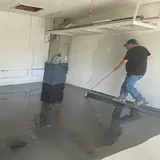
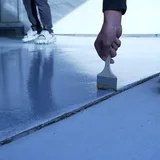
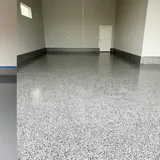
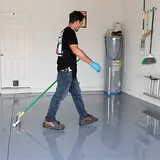
A garage floor job is three jobs stacked: prepare the slab, build the film, seal the aggregate. In order, the slab is mechanically profiled, moving cracks and control joints are routed and filled with a flexible material such as EC-72 Epoxy Patch Gel, a penetrating primer such as EC-12 goes down, a base coat is laid and the first aggregate is broadcast into it while the resin is still wet, a binder coat receives a second broadcast, and a topcoat finishes the surface.
Because these systems are 100% solids, there is no solvent to evaporate. What is applied is the film left behind, which is why the wet coats can be specified and checked in mils of dry film thickness.
| Layer | Published build | What it does |
|---|---|---|
| Primer | 3-5 mils | Wets out the profile and seals slab porosity |
| Base coat with first broadcast | 20 mils | Keys the aggregate into the bond line |
| Binder coat with second broadcast | Broadcast-driven | Stacks grain so impact is shared across the matrix |
| Pigmented topcoat | 15 mils | Seals the aggregate and becomes the surface you walk on |
Professional double-broadcast builds land at 20-35 mils DFT. A retail DIY kit lands at 2-5 mils, roughly the thickness of a sheet of paper, and those floors typically fail inside 24 months.
Prep decides the lifetime: CSP 3-4, not acid etching
Nothing else on the job matters as much as the profile left on the concrete. Laitance - the weak, cement-rich layer that rises as a slab cures - looks like concrete and behaves like chalk, and a coating bonded to laitance is bonded to powder. Mechanical preparation removes it and opens the pore structure so the resin can physically interlock.
The published standard for a heavy-duty broadcast system is an ICRI Concrete Surface Profile of 3-4, reached with a walk-behind shot blaster on the open field or planetary diamond grinders where a machine will not fit, then hand grinders at the stem wall, the door apron and around post bases. Field, edges and corners all have to reach the same number, because garage floors usually start failing at the perimeter and work inward.
| Method | Profile reached | What it leaves behind |
|---|---|---|
| Acid etch | CSP 1 | Existing sealers and oil in place, no mechanical bite |
| Shot blast or diamond grind | CSP 3-4 | Bare, open concrete with a measurable anchor pattern |
Grinding and blasting release crystalline silica, so a HEPA collector is run at the tool head. If your quotes do not say how the slab will be profiled and how the dust will be contained, the most important line is missing.
Why a Reno garage slab is a hard test
Reno is high desert: low humidity, a wide daily swing, intense UV and real winters. NWS records for Reno-Tahoe International Airport run from a mean high near 45 F in January to near 90 F in July, with an all-time record of 108 F on 16 July 2023 and a record low of -16 F on 7 Feb 1989. Average July relative humidity sits near 30%. A west-facing overhead door turns that into surface heat by mid-afternoon, and the same slab sees snow and ice-melt chemicals in February.
Ground conditions add to the load. The Reno soil series is formed in alluvium on alluvial fans, with a duripan at 50-100 cm and low saturated hydraulic conductivity, so water that reaches the slab does not drain away quickly. The Washoe series on the terraces carries 35-50% rock fragments. Movement, moisture and abrasion all arrive on the same slab.
Heat is why the topcoat spec matters more than the brand on the pail. A hot tire transfers pavement-level heat into the film. A thermoplastic coating softens, the cooling tire grips it, and the coating tears off in a tire-shaped patch. A thermoset topcoat does not re-soften, and professional cyclic polyaspartic and epoxy bonds hold at 140 F pavement temperatures with zero delamination.
Local note for Sun Valley
Sun Valley sits on the hills north of Reno, which is the ground USDA-NRCS typed as the Flex series - very shallow to weathered volcanic bedrock, roughly 15-30 cm to rock on the hills of northwest Reno (https://soilseries.sc.egov.usda.gov/OSD_Docs/F/FLEX.html). Thin soil over weathered volcanic rock is an entirely different problem from river-bottom moisture: the slab is close to a material that moves and drains in its own way, so cracking and slab movement matter more here than a rising water table does.
Sun Valley is served by the same community-owned authority as the rest of Washoe County - Truckee Meadows Water Authority, which supplies 475,000+ residents of Reno, Sparks and Washoe County from the Truckee River system (https://tmwa.com/). Neighbourhood quality varies across the system: Central and Southeast Reno measured 62 mg/L (3.6 gpg) hardness in Q1 2026 against 238 mg/L (13 gpg) in Southwest Reno (https://tmwa.com/water_quality/central-southeast-reno).
Utility accounts: Truckee Meadows Water Authority (TMWA) · 775-834-8177
Checking a quote in Sun Valley
- Who measures the slab, and is the area on the quote in square feet rather than a standard garage?
- What moisture test was run, and what were the readings (ASTM F1869 in lbs/1000 sq ft, or ASTM F2170 in % RH)?
- What surface profile is specified and how is it produced - grinding or shot blasting, to which ICRI CSP number?
- What dry film thickness is specified per coat, and which system is being quoted (flake, polyaspartic, metallic)?
- What does the workmanship warranty cover, separately from the manufacturer material warranty?
Frequently asked questions
How much does a garage epoxy floor cost in Reno?
Published figures put a flake system at $3-8 per square foot and polyaspartic at $5-9 per square foot, with professional installs generally running $5.00 to $15.00 per square foot depending on the slab. A two-car garage typically lands between $2,500 and $6,000 installed. The spread reflects how much preparation the slab needs, so two identical-looking garages can quote differently.
How soon can I park on a new garage floor?
Polyaspartic systems allow foot traffic in as little as 24 hours. For a slower build, pedestrian traffic is prohibited for 0-48 hours, vehicle traffic is not permitted before 72 hours, and full cure and heavy abrasion resistance arrive at five days. Follow the matched pro's written schedule for your specific system.
Do I really need a moisture test in a dry climate like Reno?
Yes. Low outdoor humidity does not mean a dry slab. Testing is done to ASTM F1869 for moisture vapor emission and ASTM F2170 for relative humidity inside the slab, with thresholds of 5 lbs per 1,000 sq ft per 24 hours and 75% RH. Above either limit the system needs a vapor barrier such as EC-15.